
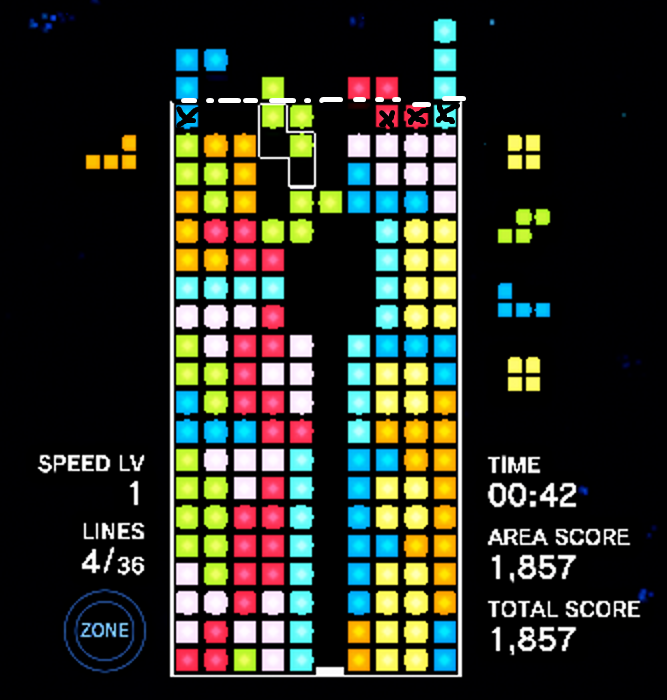
In Tetris Effect, excelling at higher difficulty levels demands more than just quick reflexes; it requires a deep understanding of the game’s rotation mechanics and effective key press strategies. Below are essential techniques that can significantly enhance your gameplay, derived from advanced community guides and established rotation systems.
Key Techniques for Advanced Play
1. Super Rotation System (SRS):
– Description: Tetris Effect employs a Super Rotation System similar to that found in many modern Tetris games. This system performs several collision tests (known as “wall kicks”) when a tetromino cannot rotate in its current position. As a result, the piece can slide into cramped spaces with slight positional adjustments during its rotation.
– Benefit: This technique proves invaluable for navigating tight areas or placing pieces beneath overhangs, enhancing your ability to make precise placements under pressure.
2. Initial Rotation System (IRS):
– Description: By holding down a rotation button just prior to a tetromino’s spawn, players can enter a pre-rotated state. This method allows the piece to appear in a specific orientation, perfectly suited for tight spots at the top of the board or in clustered stacks.
– Benefit: This allows for efficient placements, significantly reducing the risk of topping out during intense gameplay scenarios or in “Zone” mode, where every second counts.
3. Finesse Optimization:
– Description: Advanced Tetris players focus on minimizing unnecessary movements, using the most direct route to place tetrominoes. A common technique is the “two-step finesse,” which involves a horizontal move followed by a rotation before the piece is dropped.
– Benefit: By cutting down on “finesse faults,” or unnecessary rotations and movements, players can improve both speed and accuracy, allowing for quicker and more reliable piece placements even under stress.
4. Advanced Rotations (S/Z-Spins):
– Description: Mastering complex manipulations like vertical S and Z spins can create opportunities to clear lines or fit pieces into extremely narrow openings. These advanced maneuvers typically involve chaining rotations (e.g., rotating counter-clockwise followed by a clockwise rotation).
– Benefit: Developing an understanding of these patterns enables players to “slide” tetrominoes into hard-to-access gaps, essential for maintaining a clean stack and avoiding game-ending situations.
Practical Tips Summary
| Technique | Description | Benefit |
|—————————|—————————————————————————————————|——————————————————-|
| Super Rotation System | Enables rotation with offset tests to fit pieces in tight spots | Facilitates fitting in cramped spaces via wall kicks |
| Initial Rotation System | Allows for the spawning of already rotated pieces by holding a rotation button before they appear | Prevents topping out and aids in executing tight fits |
| Two-Step Finesse | Promotes optimized movement by performing two direct actions (move + rotate) before dropping | Reduces key presses, enhancing speed and accuracy |
| S/Z-Spins | Incorporates chained rotations to position S/Z pieces vertically in confined areas | Allows for fitting and clearing lines in narrow gaps |
Conclusion
By mastering these advanced rotation and finesse techniques in Tetris Effect, players can vastly improve their ability to maneuver tetrominoes into tight spaces, especially under high-stakes conditions. The effectiveness of these strategies lies in their ability to amplify both precision and speed, crucial elements for success in this visually stunning and challenging iteration of Tetris.
For those interested in gaining further insights, it’s recommended to explore in-depth video tutorials that showcase these rotation techniques and finesse optimization strategies firsthand, especially for visual learners seeking to refine their skills.
Leave a Reply