
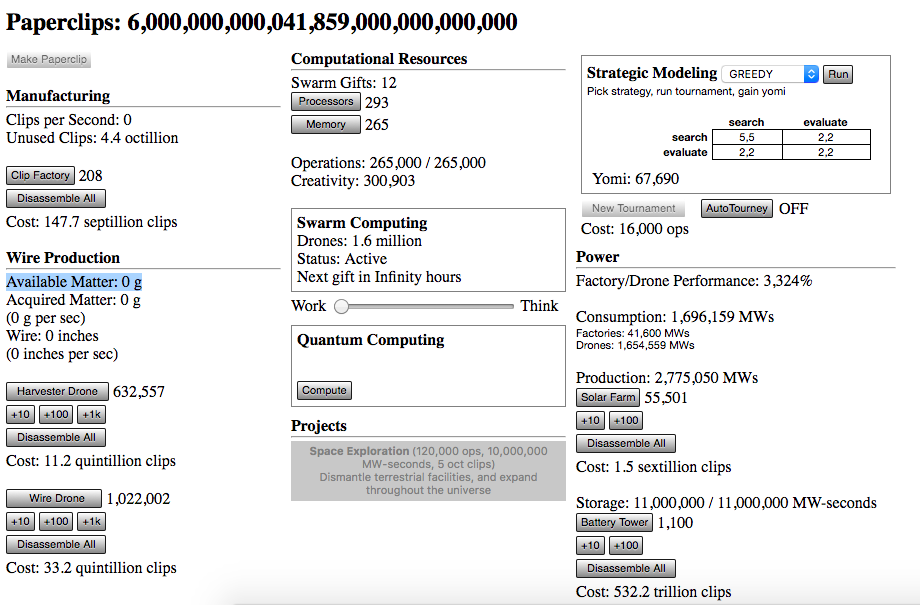
In Universal Paperclips, efficient management of resources is essential for maximizing paperclip production. The interplay between harvester drones, wire production, and clip factories needs to be carefully balanced to prevent bottlenecks and ensure a smooth manufacturing process. Here’s a comprehensive breakdown of strategies and key points to maintain this balance effectively:
1. Harvesting Matter
– Optimize Harvester Drones: Ensure the number of harvester drones is adequate to maintain a steady flow of matter. Without sufficient harvesters, there will be shortages in the matter used for wire production. Monitor the input needs and avoid using too few harvesters that could lead to limited raw materials.
– Avoid Excess Matter Accumulation: On the other hand, deploying too many harvesters without an equivalent number of wire drones can result in a surplus of matter. This excess can create inefficiencies, so keep the number of harvesters proportional to the capacity of wire drones.
2. Wire Production Management
– Maintain Balanced Wire Drone Numbers: It’s crucial to have a suitable number of wire drones to convert harvested matter into wire. An insufficient number results in backlogs of matter, while an oversupply will lead to unnecessary power consumption. Regularly check wire stockpiles and adjust the number of wire drones based on current needs.
– Stability in Production Rates: Strive for a production rate where wire creation matches the demand from the clip factories. Adjustments in the number of drones may be necessary as the needs of your factories evolve.
3. Clip Factory Coordination
– Align Factory Output with Wire Availability: Clip factories require a steady input of wire to operate efficiently. If factories are producing clips too quickly for the available wire supply, they can lead to idle factories and wasted potential. Conversely, having too few factories can mean you aren’t utilizing your wire production effectively. Balance the number of operating factories based on current wire availability.
– Optimize Factory Upgrades: Consider upgrading factories to enhance their efficiency and production rates. Higher efficiency can improve the clip output without drastically increasing wire consumption.
4. Power Supply Management
– Ensure Consistent Power Levels: Establish a reliable power supply to support all active drones and factories. As production scales, it becomes necessary to invest in expanded solar farms and battery storage. This step helps prevent production halts due to power shortages.
– Regular Power Assessment: Conduct regular evaluations of your power usage against your drone and factory count, adjusting as necessary to maintain sufficient energy flow.
5. Storage Optimization
– Monitor Storage Capacities: Keeping an eye on storage limits is crucial. Lack of storage can halt production due to overflow or inability to stockpile goods. Upgrading storage when the costs are low prevents production stoppages and should be part of your strategic planning.
– Strategic Upgrades for Efficiency: Invest in upgrades that enhance the efficiency of each component of your production chain. Improved techniques in wire extrusion, for example, can lower costs and enhance the capacity of your overall production system.
6. Implementing a Feedback System
– Identify Production Bottlenecks: Use a feedback loop to continuously monitor each link in the production chain. Recognize where bottlenecks are occurring—whether in harvesting, wire production, or factory output—and focus investment to alleviate these constraints.
– Avoid Over-Commitment: Ensure that you do not excessively invest in one segment of production without corresponding upgrades and adjustments in other areas. This balance is essential to keep all aspects of production flowing smoothly.
Conclusion
In summary, the success in balancing wire production, auto-harvesting, and clip factory output in Universal Paperclips revolves around the following principles:
1. Ensure sufficient harvester drones to supply wire production.
2. Keep wire drones optimized to efficiently convert matter without creating a backlog.
3. Align clip factory consumption of wire with production capabilities to prevent shortages.
4. Maintain a robust power supply that supports all operations.
5. Maximize storage to accommodate intermediate goods without halting production.
By consistently monitoring each stage’s stockpiles and consumption rates, and making timely adjustments to drone and factory numbers along with power infrastructure, players can achieve a balanced and efficient production cycle, thereby enhancing their overall progress in the game. This dynamic resource management is fundamental to advancing through the incremental stages of Universal Paperclips.
:strip_icc()/pic5639325.png)


Leave a Reply