
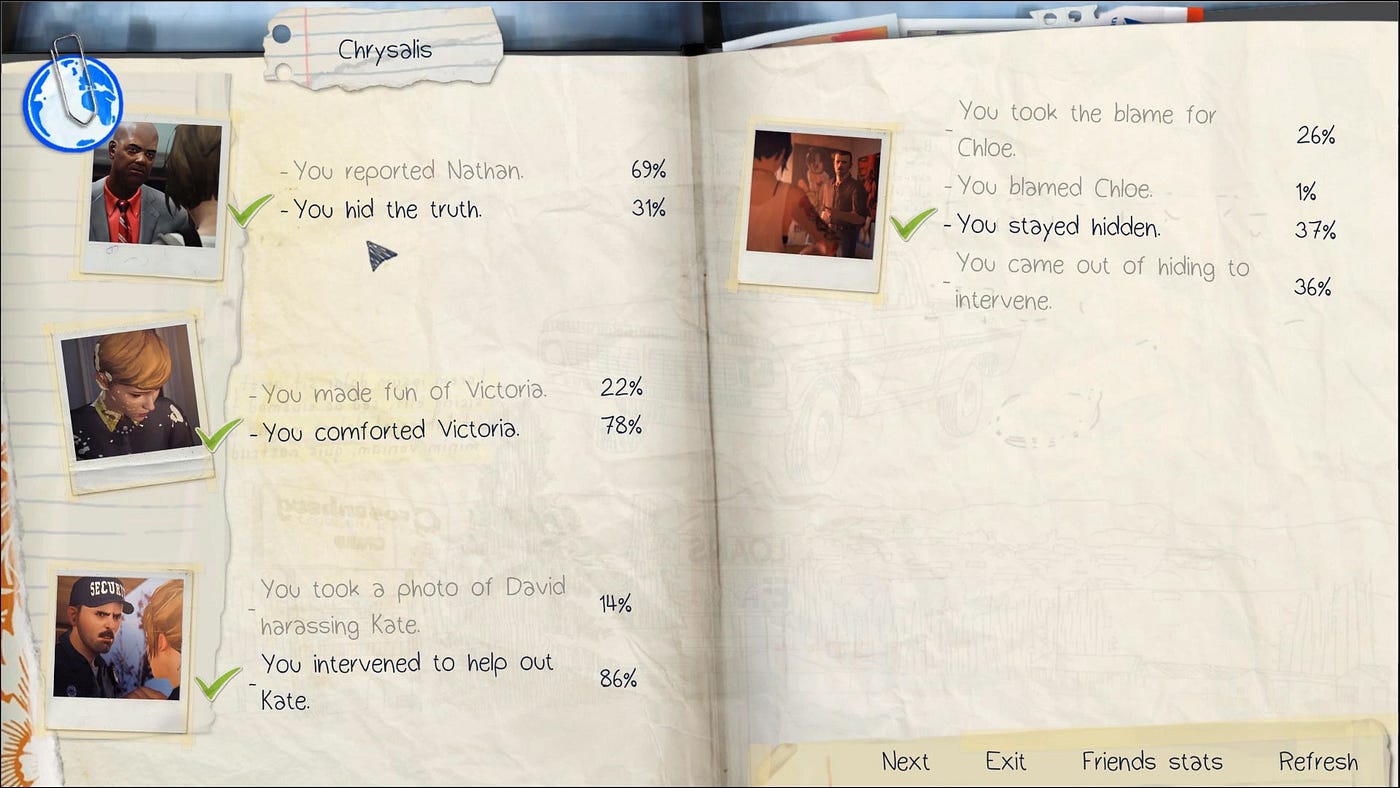
In Life Is Strange, player choices play a significant role in shaping the narrative and character dynamics, though they operate within a structured framework that maintains a consistent overall story arc. Players navigate a world where their decisions not only impact immediate interactions but also set in motion key events that lead to varying character fates and emotional landscapes.
Choice and Consequence
At the heart of the game lies a unique time-rewind mechanic that allows players to revisit and reconsider their decisions. This mechanic not only underscores ethical dilemmas but also enhances players’ connection to the character of Max as she grapples with the weight of her choices. Players can observe the repercussions of their actions, encouraging a deeper exploration of personal morality and the complexities of relationships within the narrative.
Character Impact
Key characters, such as Kate and Chloe, are particularly affected by player decisions, which can lead to drastically different outcomes based on how players choose to navigate pivotal moments in Episodes 1 and 2. For example, players’ choices regarding Kate can influence her survival and overall well-being, while Chloe’s experiences and potential outcomes hinge significantly on Max’s actions and the exercise of her powers throughout the game.
Major Plot Points and Relationships
Despite the presence of numerous “This choice will have consequences” scenarios, the crux of the narrative remains tied to the relationship between Max and Chloe. Most decisions funnel toward the overarching theme of this bond, particularly in the climax where players face the monumental decision that determines the fate of Arcadia Bay. This theme of cosmic balance is highlighted in the game, where saving Chloe ultimately disrupts the universe’s equilibrium, leading to catastrophic consequences.
Emotional Nuance vs. Narrative Structure
In addition to major story outcomes, players can explore subtle relationship nuances, such as choosing to kiss either Warren or Chloe. While these choices add depth and personal engagement to the gameplay, they do not drastically alter the core resolution of the game. Instead, the narrative maintains a relatively fixed trajectory focused on the development of Max and Chloe’s relationship throughout their journey.
Narrative Design
The design of Life Is Strange deftly balances small, meaningful choices that enhance emotional investment with a tightly constructed narrative arc. While the game promotes the idea that “every choice matters” as a thematic principle, the reality is that the degree of branching in terms of the story’s overall direction is comparatively limited when juxtaposed with other choice-driven games.
Conclusion
To summarize, Life Is Strange intricately weaves player choices into its narrative fabric, fostering character development and emotional engagement while adhering to a core storyline centered around Max and Chloe. The structure ensures that while players experience a personalized story marked by moral decisions, the essential journey and its resolution ultimately unfold along a largely predetermined path, encapsulating both the power and limitations of choice in interactive storytelling.




Leave a Reply