
Efficient management of trade routes in Anno 1800 between multiple islands is essential for ensuring a flourishing economy. Below is a comprehensive guide designed to optimize your trade logistics through strategic planning and management.
Key Concepts for Efficient Trade Routes
1. Manual vs. Automated Routes
– Manual Trade: This method involves directly loading goods onto a ship, sailing it to another island, and unloading. It’s advantageous for one-off transfers or urgent supply needs but can be labor-intensive.
– Automated Trade Routes: Setting up automated routes allows ships to continuously transport goods between islands without your constant oversight. This is particularly beneficial for regular trade flows, as it minimizes the need for micromanagement and ensures a reliable supply chain.
2. Warehouses and Piers
– Spread Piers: Distributing multiple piers around the perimeter of your islands reduces congestion, as ships can dock at the nearest pier rather than all queuing at one location.
– Warehouse Capacity: Ensure that production chains have adequate warehouse space. If goods exceed storage capacity, production can halt, disrupting your entire supply chain.
How to Set Up and Manage Automated Trade Routes
1. Create a Trade Route
– Select a ship and assign it to a new trade route. Then choose the islands or the NPC traders as both the source and destination.
2. Choose the Right Ship Type
– Schooner/Clappers: Best for early-game short-distance trade with low volumes.
– Cargo Ships: Suitable for mid to late-game, offering a larger cargo capacity and faster travel, making them ideal for high-volume trade across longer distances.
3. Configure the Route
– Define Goods: Identify the specific goods to transport.
– Set Maximum Loads: Establish load limits for each item to prevent ships from carrying excess or insufficient goods.
– Assign Actions: For every stop, specify whether the ship should load, unload, or both.
4. Multi-Island Route Management
– Hub-and-Spoke Model: Designate a central island as a distribution hub. Use feeder routes to transport goods to this hub, then redistribute to other islands.
– Balancer Routes: Set minimum and maximum storage thresholds for each destination, ensuring that ships only drop off goods when necessary, assisting in maintaining balanced supply levels.
– Direct Feeder Routes: Implement direct routes for high-demand goods, transporting them straight from production islands to consumer islands.
5. Monitoring and Adjusting Routes
– Statistics Screen: Regularly review the statistics screen to monitor the flow and consumption of goods.
– Overflow Management: Use the “drop-off only if below” setting to prevent excess goods that could fill up storage at destination islands.
– Timely Adjustments: Consider travel time when setting routes; longer journeys may necessitate faster ships or multiple vessels to ensure steady supply.
Advanced Tips
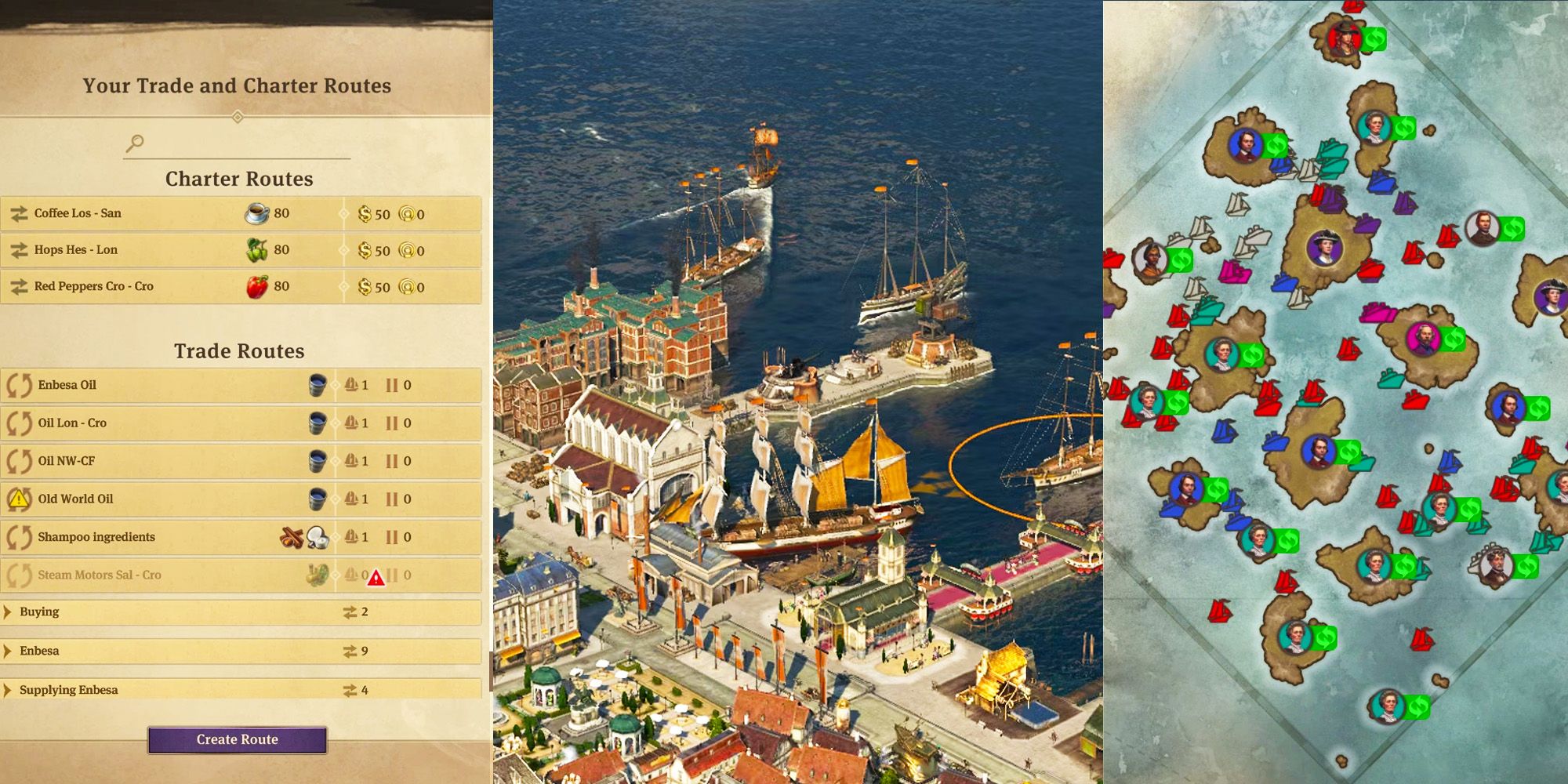
– Charter Routes: Utilize charter routes (available in DLCs) to automate trade with neutral NPCs without deploying your ships.
– Route Organization: Clearly label and categorize your routes to manage the logistics effectively, especially as your trading network expands.
– Ship Upgrades: As demand increases, invest in faster and larger vessels to accommodate your growing empire’s needs.
– Avoid Overloading Ships: Keep an eye on the cargo each ship carries. Overloading can hinder efficiency, especially if a ship’s hold isn’t optimized for the goods it’s transporting.
Example of an Efficient Trade Route Structure
Consider a scenario with three islands: Island A (production), Island B (hub), and Island C (consumer).
1. Feeder Route: A ship carries goods from Island A to Island B (hub).
2. Distribution Route: Ships at Island B distribute goods to various islands, including Island C, utilizing balancer logic to ensure goods are only delivered when needed.
3. Local Routes: Additionally, set up special routes for particularly high-demand goods directly connecting Island A and Island C.
Summary Table
| Step | Details |
|—————————–|————————————————————————————–|
| Manual/automated trade | Use automated for routine, manual for occasional/emergency needs |
| Multiple piers | Distribute around the island to eliminate bottlenecks |
| Warehouse management | Maintain ample storage to avoid production halts |
| Ship selection | Early game: Schooner/Clapper; Mid/late game: Cargo ships |
| Route configuration | Specify pick-up/drop-off actions and load limits |
| Statistics monitoring | Check the storage tab to track goods flow |
| Advanced options | Consider charter routes, effective labeling, and upgrading ships |
Applying these strategies will help you manage trade routes effectively, ensuring the steady flow of goods between your islands in Anno 1800, promoting a sustainable and prosperous economic environment.


Leave a Reply