
In Beat Saber, the presence of bombs and walls adds a layer of complexity and challenge that significantly influences a player’s movement strategy. Their characteristics and effects on gameplay are as follows:
Bombs
Functionality:
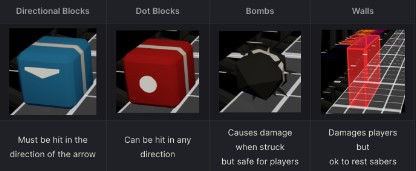
Bombs are designed as detrimental obstacles that must be avoided at all costs. They cannot be sliced and will result in a negative impact on the player’s score if struck.
Impact on Movement Strategy:
When a bomb is encountered, players must immediately redirect their focus to avoid making contact. This situation often necessitates a momentary cessation of slicing motions or an abrupt alteration in body position and movements to ensure they sidestep these hazards. Although failing to hit bombs does not contribute to the overall score, making contact will reduce the player’s combo streak, which can hinder performance and lower the final score.
Strategic Movement:
To navigate around bombs effectively, players must maintain a high level of attentiveness. This requires not only quick reflexes but also a keen eye to identify the appearance and placement of bombs in real time. Players might need to execute specific maneuvers, such as a quick shuffle to the side or a brief pause in their slicing rhythm to avoid hitting the bombs.
Walls
Functionality:
Walls serve as physical barriers that impede players’ ability to slice through them. Their presence indicates areas that players must navigate around rather than attempt to interact with.
Impact on Movement Strategy:
Walls compel players to modify their movements to accommodate these barriers. Success in avoiding walls means players must either time their actions carefully or alter the angle at which they attempt to slice incoming blocks. This requires preemptive planning about where blocks will appear in relation to wall placements.
Strategic Movement:
Given the unpredictable nature of wall locations in various maps, players need a solid understanding of the level design to anticipate difficulties. This foresight is crucial, as misjudging wall placement could lead to collisions that halt progress and compromise the player’s score. Thus, walls necessitate fluid and adaptive movement strategies.
General Movement Strategy
Adaptability:
The challenges presented by both bombs and walls require players to be agile, both mentally and physically. Quick adjustments in slicing patterns or body movements are essential to maintain rhythm while navigating these obstacles.
Awareness:
Maintaining a heightened awareness of the game environment is critical for successful gameplay. Being able to foresee and react to bombs and walls effectively elevates a player’s performance, allowing them to plan their movements several beats ahead, which is vital in a rhythm-based game.
Timing and Precision:
Beat Saber’s gameplay hinges on precise timing and movement control. Players must position themselves accurately to slice through blocks without impinging upon the walls or bombs. This balance of rhythmic movement and spatial awareness enhances the player’s overall proficiency in the game.
Conclusion
In summary, the integration of bombs and walls in Beat Saber significantly enriches the gaming experience by introducing layers of challenge that demand sophisticated movement strategies. Players must cultivate their rhythm, timing, and spatial awareness to dodge these obstacles while achieving high scores, ultimately contributing to a more engaging and challenging gameplay experience. The need for adaptability, awareness, and precision shapes the skills that players develop as they refine their Beat Saber techniques.


Leave a Reply